The Invisible Epidemic: Why Your Plant is Burning Profits Right Now

Abstract
The article reveals how hidden accident processes silently erode chemical plant performance despite perfect compliance. It introduces a 4th Era safety framework that uncovers core asset misalignments, prevents invisible environmental degradation and helps manufacturers break free from recurring issues and profit loss.
Introduction

The top management of a chemical manufacturing company gathers in the boardroom, with the CEO, COO, CFO, Plant Head, Maintenance Head and Safety Head; each a seasoned professional with decades of experience. They have just presented their safety metrics: 100% compliance with regulatory standards, comprehensive training programs, state-of the-art monitoring systems and meticulous adherence to every protocol. Yet the COO’s report tells a different story. Recurring batch failures, unexplained quality variations,equipment behaving mysteriously, profit marginsshrinking despite operational excellence. The frustration in the room is palpable.“We’re doing everything right,” the CEO says, leaning forward. “So why do these problems keep repeating?” I’ve sat in similar boardrooms across the industry, from facilities producing specialty chemicals to pharmaceutical intermediates. They’re achieving perfect scores on safety audits while watching their profits evaporate through “unexplainable” variations, mysterious inefficiencies and recurring quality issues.
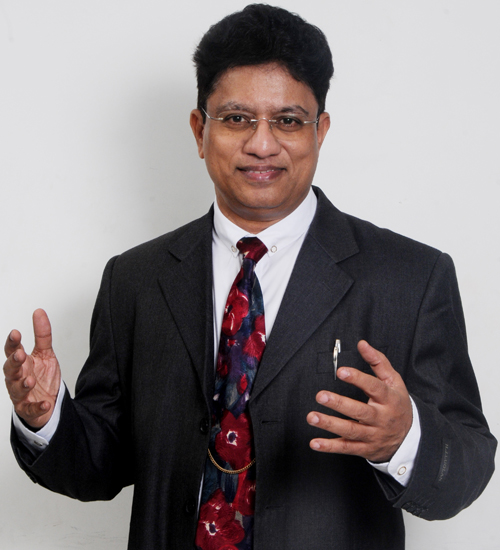
Rajendra Utturkar is a chemical engineer with over40 years of experience in chemical manufacturing and author of “Earn Or Burn Your Profits.” He has developed the revolutionary PARASMANI™methodology and SEPLO Process for implementing the NextGen 4th Era of Process Safety Management Systems globally. He serves as CEO and business growth coach to chemical manufacturing business owners seeking to transform safety challenges into profit opportunities. The uncomfortable truth? Their plants are experiencing accidents right now—accidents their safety systems are completely blind to. For four decades, my career has spanned everycorner of chemical manufacturing; from design and engineering to plant operations and leadership discussions. I’ve examined major disasters and nearmisses, reviewed thousands of incident reports and spent ten years investigating why accidents continue to recur despite strong systems and good intentions. What I uncovered has challenged long held industry assumptions about safety and inspired a groundbreaking approach that is helping chemical manufacturers break free from constant firefighting and stagnant profitability.
The Broken Mirror
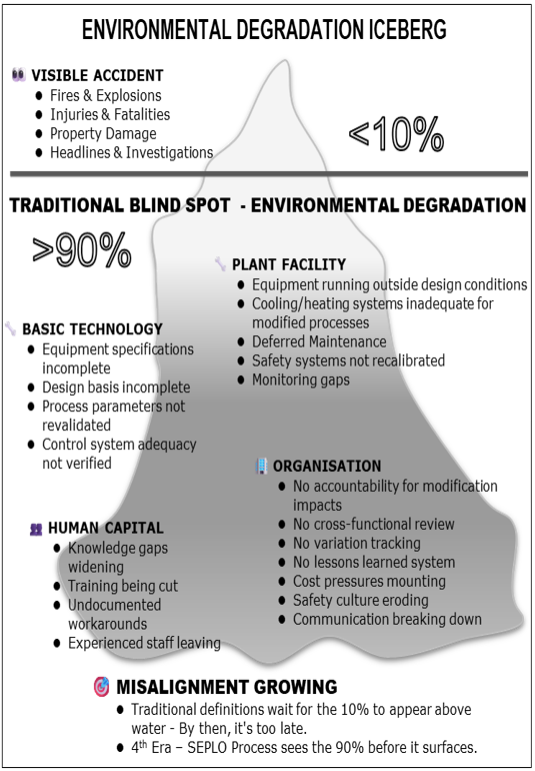
Let me ask you something: What is an accident? If you’re like most chemical manufacturing professionals, you’ll recite the definition we’ve inherited from 130 years of industrial practice: “An incident that is unplanned, unintentional, uncontrolled and not inevitable leading to property damage, personal injury, illhealth or fatality.”This insurance-focused definition has shaped every safety protocol, every regulatory framework, everyinvestigation procedure in our industry. It’s the lens through which we view risk. And its precisely why accidents keep repeating. This traditional definition creates a catastrophic blind spot. It only recognizes incidents after visible damage has occurred—after equipment has failed, after someone is injured, after property is destroyed. It’s like using a rear-view mirror to drive forward. By the time you see the accident in this mirror, the damage is done.But here’s what haunts me: while this definition waits for visible damage, your plant’s operational environment is degrading every single day. Assets are weakening. Misalignments are growing. Accident processes are building toward completion.You just can’t see them yet.
The Bhopal Revelation
December 3, 1984. Bhopal. The world’s worst industrial disaster. Every analysis focuses on the visible causes: Methyl isocyanate gas leaked from tank
E610. Safety systems failed. Operators made errors. Maintenance was inadequate. Emergency response was insufficient.But when I applied my PARASMANI™ drilling methodology to Bhopal, peeling back layer after layer of cause and effect. I discovered something that transformed my understanding of accidents forever.
The real catastrophe didn’t begin on December 2nd when water entered the MIC tank. It began years earlier when Union Carbide faced a financial crisis. Unable
to maintain profitability, they progressively weakened four critical business assets: their technology implementation, their plant facilities, their human capital
and their organisational systems.They reduced staff from 850 to 642. They eliminated the night shift supervisor. They postponed critical
maintenance. They compromised on operator training. They modified safety systems to reduce costs. Each decision seemed justifiable in isolation. Each appeared to
be a reasonable response to financial pressure. What they didn’t see or what their traditional accident definition couldn’t show them was that they
were systematically damaging their operational environment. The accident process was already happening. The MIC leak wasn’t the cause; it was merely the moment when an ongoing accident process completed its cycle. Think about that. An accident that was already happening, invisible to every safety system, every compliance audit, every regulatory inspection. Visible only in retrospect.
The Epidemic in Your Plant
A few months back, I worked with a scenario I’ve encountered repeatedly across multiple client engagements—the pattern is so consistent, it represents a
composite of typical situations in specialty chemicals manufacturing. Consider a specialty chemicals manufacturer with annual revenue around ₹38 crores. Every 4-6 weeks, they experience batch failures—product flexibility at 60°C varying unpredictably. Off-spec material. Customer complaints. Rework costs mounting steadily. Their traditional root cause analysis identified two separate issues: inadequate catalyst weighing precision and insufficient cooling capacity. The conventional approach would be straightforward: implement better weighing procedures, upgrade cooling systems.But when I applied the PARASMANI™ methodology to drill deeper, what emerged stunned the entire management team.Those weren’t two separate root causes at all. They were two visible branches emerging from a single, invisible root, a fundamental misalignment among their four core business assets. Their technology had evolved to complex specialty chemicals, but their plant facilities, human capital capabilities and organisational systems remained aligned to their previous, simpler product portfolio.This one core misalignment was creating not just those two visible problems but dozens of “minor issues” across their operation. Quality variations they attributed to “process complexity.” Equipment limitations they accepted as “capacity constraints.” Training gaps they dismissed as “operator learning curves.”
All symptoms of the same root cause. All accidents already happening, invisible to their traditional safety framework.When we addressed this core misalignment, synchronising all four assets to match their current technology complexity. We didn’t just solve the batch failure problem. We eliminated 17 other recurring issues simultaneously. The typical annual profit impact from this type of intervention: ₹2.4+ crores.From one intervention. Because we treated the disease, not the symptoms.
Redefining Reality
After years of research and application across global chemical manufacturing facilities, I’ve developed what I call the SEPLO Process – the NextGen 4th Era
of Process Safety Management Systems. At its foundation is a completely redefined understanding of what an accident truly is:“An incident that leads to damaging the
environment.”Notice what this definition does. It shifts focus from visible outcomes (injury, property damage) to environmental degradation—the weakening of your operational environment before catastrophic failure occurs. This isn’t semantic wordplay. This is a paradigm shift that expands your vision from visible disasters to the invisible accident processes currently unfolding in your facility.In this new definition, everything changes.That recurring quality issue? That’s an accident—
environmental damage to your production system’s integrity.That unexplained efficiency loss? Accident—environmental degradation of your asset synchronisation.
That “minor” equipment wear pattern everyone has learned to work around? Accident—progressive weakening of your facility environment.Traditional definitions wait for explosions. The new definition sees the pressure building.Traditional definitions count injuries. The new definition measures environmental health.Traditional definitions react to disasters. The new definition prevents accident processes from completing.
The Four Pillars of Environmental Health
The 4th Era PSMS recognises a truth that aerospace and nuclear industries have understood for decades but chemical manufacturing has largely ignored: safety isn’t delivered through compliance checklists. Safety is delivered through the holistic synchronisation of four core business assets.
Organisation — Your management systems, decision-making processes, resource allocation philosophy and operational culture. Organisational weakness is environmental damage that manifests across all other assets.When these four assets are synchronised and robust, your operational environment is healthy. Accident processes cannot build. When any asset weakens or becomes misaligned, environmental degradation begins—the accident is already happening.The question isn’t whether you’ll have an accident.
The question is whether you’ll see it before it completes.
The PARASMANI™ Difference
Traditional root cause analysis stops at obvious causes.Equipment failed? Fix the equipment.Operator error? Improve training.Process deviated? Tighten controls.
These are surface findings—symptoms visible in the rear-view mirror. The PARASMANI™ methodology drills down through cause-by-cause chains, layer by layer, following invisible connections until reaching what I call the Parasmani—the golden thread that ties together multiple problems across your operation.Minimum 10 layers. Sometimes 15 or 20, drilling to rock bottom until we find the true underlying reason for likely accidents. Layer 1 might show a quality issue. Layer 5 might reveal a design limitation. Layer 10 typically uncovers the fundamental asset misalignment that’s creating dozens of problems you’ve been treating as unrelated. This is why fixing the Parasmani solves multiple problems simultaneously. Because they’re not sepa rate problems—they’re different manifestations of the same root cause. Think about your facility right now. How many “minor issues” do you have? How many quality variations, efficiency losses, maintenance patterns, work arounds and operational constraints have you learned to accept as “just how things are”? What if they’re all branches from one root tree? What if addressing that root would eliminate not just one problem, but dozens? What if the profit you’re burning isn’t in the major accidents you’re preventing, but in the invisible accident processes you’re not even aware are happening?
Breaking Free
The chemical industry has evolved through distincteras of safety management, each triggered by the recognition that previous approaches couldn’t prevent major disasters.
The 1st Era—The Technological Factor: Focused on developing fit-for-purpose processes and technologies. Unsafe situations arose from improper process recipes and inaccurate operating conditions. Engineers developed risk assessment abilities, leading to more robust and reliable hardware and software.
The 2nd Era—The Human Factor: Emerged when accidents continued despite resolved technological issues. Human errors in larger capacity plants had catastrophic consequences. This era gave birth to Process Safety Management and Loss Prevention, taking shape profoundly after the Bhopal accident in 1984.
 
The 3rd Era—The Organisational Factor: Sparked by disasters like Chernobyl (1986) and Exxon Valdez (1989). This era recognised organisational factors: belief systems, thought processes, perceptions, leadership and culture as root causes. It brought a paradigm shift; human errors and technological failures were now viewed as consequences rather than causes, mere tips of a much larger problem iceberg. Current best practices exist firmly in this 3rd Era. And accidents keep repeating.
 
The 4th Era—The Holistic Approach: Practiced in spaceship and atomic energy industries but virtually unknown in chemical manufacturing – integrates technological, human and organisational factors to account for their complex interactions and interdependence. Through my book “Earn Or Burn Your Profits” and the SEPLO Process, I’ve developed the first holistic 4th Era PSMS framework specifically for chemical process industries.This is not another layer of compliance. This is a fundamental transformation of how you see your operation. From reactive crisis management to proactive environmental health management. From treating symptoms to strengthening assets. From burning profits on endless firefighting to earning profits through synchronised operational excellence.
Conclusion - The Choice

Accident processes are unfolding in chemical plants around the world. Equipment is degrading. Skills gaps are widening. Technologies are misaligning. Organisations are weakening. Traditional definitions can’t see these accidents. Traditional safety systems can’t stop them. Traditional approaches can’t break the cycle. You have a choice. Continue with the broken definition that has governed our industry for 130 years—the definition that waits for visible damage, that treats symptoms, that keeps you trapped in the vicious circle of repeating incidents and limited profits.Or embrace the NextGen 4th Era of PSMS. See the accidents already happening in your facility. Drill down to find your Parasmani. Strengthen and synchronise your four core business assets. Transform environmental vulnerabilities into competitive advantages.
The expertise required for this transformation cannot be found through traditional safety consultants operating within the same flawed paradigm. This is not incremental improvement. This is revolutionary transformation. And it starts with one question: Are you ready to see the accidents you’ve been blind to? The invisible epidemic is real. The accidents are happening now. The profits are burning. But you can apply a full stop to all likely accidents. You can break out of the vicious circle. You can transform your chemical manufacturing operation from a crisis-prone profit burner to an optimised profit generator.
The mirror you’ve been using shows only what’s behind you. It’s time to look forward, to see the accident processes building before they complete, to strengthen the environmental health of your operation before degradation becomes catastrophic, to earn your profits instead of burning them. Your operational environment is speaking to you right now. Every variation. Every inefficiency. Every “minor” issue. The question is: Are you listening?

Reference